
Chapter 13 Repayment Plan in Massachusetts: A Reading Homeowner's Guide

You have a formidable legal tool to reclaim control of your financial future. Utilizing a chapter 13 repayment plan massachusetts allows you to stop a foreclosure sale instantly while consolidating your debt into a manageable monthly payment. This guide provides a clear framework for understanding eligibility and the strategic benefits of debt reorganization. We'll explain how the court determines your disposable income and how this 3 to 5 year commitment secures your home and leads to the discharge of remaining unsecured debts. You'll gain the tactical direction needed to move from financial crisis to long-term stability.
Key Takeaways
- Safeguard your Reading property by learning how to balance debt resolution with aggressive asset protection strategies.
- Master the structural requirements of a chapter 13 repayment plan massachusetts to ensure your filing meets the "Best Interest of Creditors" test.
- Utilize the Automatic Stay and "Cure and Maintain" tactics to immediately halt foreclosure and regain control over your mortgage.
- Navigate the confirmation hearing with confidence by understanding how Massachusetts bankruptcy judges evaluate and approve repayment proposals.
- Secure your financial well-being by partnering with local advocates who provide the strategic direction needed for a successful debt resolution.
The Chapter 13 Repayment Plan in Reading, MA: A Strategic Overview
Reading residents facing financial hardship often find that Chapter 13 bankruptcy, commonly known as the Wage Earner's Plan, offers a path toward stability that other options cannot match. This legal framework allows individuals with a regular income to restructure their obligations into a single, manageable monthly payment. The primary objective is to strike a precise balance between debt repayment and asset protection. By committing to a chapter 13 repayment plan massachusetts, you're not just resolving past-due balances; you're actively securing your family's future and maintaining ownership of your most significant investments.
In the Eastern Division of Massachusetts, the Chapter 13 Trustee serves as a central figure in your case. This official reviews your proposed budget, collects your monthly payments, and distributes those funds to your creditors. Unlike Chapter 7, which may require the liquidation of assets to satisfy debts, Chapter 13 is designed for those who have equity in their Reading property that they aren't willing to lose. It provides a structured environment where the law protects you from aggressive collection actions while you fulfill your financial obligations.
Why Reading Homeowners Choose Chapter 13
For many local families, the most urgent reason to file is to halt a foreclosure sale scheduled at the Middlesex County Registry of Deeds. The moment you file, an automatic stay goes into effect, which legally prevents lenders from seizing your home. This gives you the necessary breathing room to cure mortgage arrears over a 36 to 60-month window. Beyond saving the family home, this strategy protects non-exempt property. If you own assets that exceed the standard Massachusetts exemptions, such as a second vehicle or high-value personal property, Chapter 13 ensures you keep these items rather than seeing them sold by a trustee.
The 3-Year vs. 5-Year Plan Duration
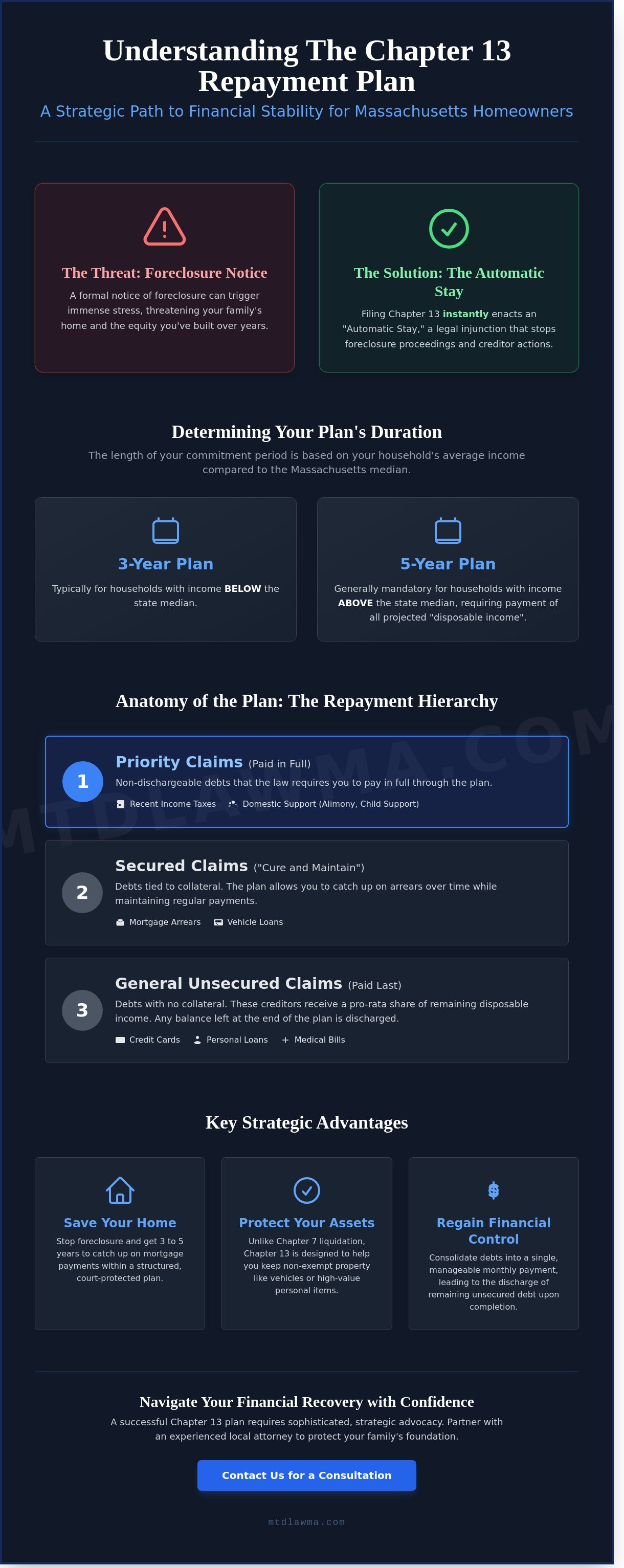
The length of your chapter 13 repayment plan massachusetts is primarily dictated by your household's average income over the six months prior to filing. If your income falls below the Massachusetts median for a household of your size, the court typically approves a three-year plan. However, if your income exceeds that median, a five-year plan is generally mandatory. The local bankruptcy court may allow "for cause" extensions in specific circumstances, such as when a debtor needs more time to pay off priority tax debts or secured arrears. For those planning a filing in 2026, the "applicable commitment period" is the specific duration, usually 60 months for high-income earners, during which you must pay all projected disposable income into the plan as outlined in Chapter 13 of the United States Bankruptcy Code. This period ensures that creditors receive the maximum possible recovery based on your financial capacity.
Anatomy of a Massachusetts Chapter 13 Plan Template
A Chapter 13 plan isn't just a monthly budget; it's a court-ordered blueprint for your financial recovery. Your chapter 13 repayment plan massachusetts must adhere to a specific template approved by the District of Massachusetts to ensure all creditors receive fair treatment under federal law. This document dictates how every dollar of your future income is allocated over a three to five year period. Recent changes in the law have shifted the landscape for many filers. While the temporary $2.75 million debt limit for Chapter 13 expired in June 2024, legal experts are closely watching for potential 2026 legislative updates that could once again expand eligibility for residents with high mortgage balances or business-related debts.
Categorizing Your Debt: The Repayment Hierarchy
The court organizes your obligations into a strict hierarchy to determine who gets paid first. This structure is designed to protect your most essential assets while addressing legal mandates. The categories include:
- Priority Claims: These are non-dischargeable debts that you must pay in full. They include recent income taxes and domestic support obligations like child support or alimony.
- Secured Claims: This category covers debts linked to collateral. For Reading homeowners, this often involves mortgage arrears or vehicle loans. The plan allows you to cure defaults over time to prevent foreclosure or repossession.
- General Unsecured Claims: Debts like credit cards, personal loans, and medical bills sit at the bottom of the hierarchy. In many Massachusetts cases, these creditors receive only a small percentage of what's owed, sometimes as low as five or ten cents on the dollar.
You can find more detailed definitions of these categories and how they function within the federal system via the U.S. Courts on Chapter 13 guidance.
The Calculation Formula
Determining your monthly payment requires a precise "Liquidation Analysis" and a "Best Interest of Creditors" test. The court's goal is to ensure that unsecured creditors receive at least as much as they would have if your non-exempt assets were sold in a Chapter 7 liquidation. To arrive at your payment amount, we subtract "reasonable and necessary" expenses from your gross monthly income. For a Reading resident, this calculation isn't arbitrary. It relies on IRS Local Standards for Middlesex County, which set specific allowances for housing, utilities, and transportation based on regional costs.
If your income exceeds the state median, the "Means Test" further refines these allowances to determine your "projected disposable income." This ensures your chapter 13 repayment plan massachusetts remains grounded in your actual ability to pay. Balancing these complex figures while protecting your home requires strategic legal advocacy to ensure the plan remains sustainable for its entire duration. By meticulously documenting your local cost-of-living expenses, you can often lower your required monthly contribution and secure a more stable financial future.
Protecting Reading Real Estate: Foreclosure Defense Strategies
The moment a Chapter 13 petition is filed, the Automatic Stay takes effect. This legal injunction immediately halts any scheduled Reading sheriff sales, providing homeowners with a critical window of protection. Under a chapter 13 repayment plan massachusetts residents can implement a "cure and maintain" strategy. This approach allows you to resume regular monthly payments while systematically paying off past-due balances over a three to five year period. For properties with high equity, the Massachusetts Homestead Act provides a vital shield, protecting up to $500,000 of equity from certain creditors when properly recorded at the Middlesex South Registry of Deeds.
This legal framework doesn't just delay the inevitable; it restructures your financial obligations into a sustainable format. By utilizing a chapter 13 repayment plan massachusetts, you're taking a proactive step toward long-term housing stability. Our firm acts as a steadfast partner during this process, ensuring that national mortgage servicers and local lenders alike adhere to the strict requirements of the bankruptcy code.
Curing Mortgage Arrears in Middlesex County
In Middlesex County, homeowners often face a mix of local community banks and large national servicers. A Chapter 13 plan breaks down years of accumulated missed payments into predictable monthly installments. This structure is particularly effective because it stops "dual tracking," a practice where lenders continue foreclosure proceedings while simultaneously reviewing a homeowner's application for a loan modification massachusetts. By filing, you force the lender to negotiate within the bankruptcy framework, ensuring your home remains secure while we pursue a permanent solution. This tactical response bridges the gap between your current crisis and a stable financial future.
Lien Stripping and Cramdowns
Strategic debt reduction often involves more than just rescheduling payments. If your Reading home's current market value is less than the balance of your primary mortgage, we can pursue "lien stripping" to remove second mortgages or HELOCs entirely. This process reclassifies the secondary debt as unsecured, which often results in paying only a fraction of the original balance. It's a powerful tool for those whose homes are currently underwater.
According to the Chapter 13 Bankruptcy Basics provided by the federal judiciary, this plan also allows for "cramdowns" on certain secured debts. For instance, if you've owned your vehicle for more than 910 days, we can reduce the loan balance to the car's actual fair market value. This disciplined precision in managing your assets ensures that every dollar in your plan is working toward your recovery. We don't just observe your legal challenges; we provide the analytical sharpness necessary to resolve them.
- Lien Stripping: Eliminates second mortgages if the home value is lower than the first mortgage balance.
- Cramdowns: Reduces car loan balances to the current market value of the vehicle.
- Interest Rate Reduction: Often lowers high interest rates on secured debts to a more manageable "prime plus" rate.
Confirmation and Compliance: Making the Plan Work
Your case moves toward the Confirmation Hearing after the initial filing phase. This is the pivotal moment where a Massachusetts Bankruptcy Judge reviews your proposed chapter 13 repayment plan massachusetts to ensure it meets every statutory requirement. The court applies a rigorous feasibility test during this stage. You must demonstrate that your household budget generates enough disposable income to sustain the monthly payments for the entire three to five-year term. If the court finds the budget too tight or the income unreliable, the judge won't approve the plan. We focus on building a realistic budget that satisfies the court while protecting your ability to pay for daily essentials.
Once the judge confirms the plan, you must stay disciplined with payments. Most Reading residents find success through payroll deduction. This method automatically sends the plan payment from your employer to the Trustee, which removes the risk of late fees or missed deadlines. If you're self-employed or prefer manual control, you can send direct payments to the Trustee's designated lockbox. Consistency is the key. The court expects 100% compliance to grant your eventual discharge.
The Meeting of Creditors (341 Meeting)
Approximately 30 to 45 days after your case begins, you'll attend the Meeting of Creditors. For Reading residents, these proceedings are currently held via Zoom or teleconference, saving you a trip to the courthouse. The Massachusetts Chapter 13 Trustee presides over this meeting rather than a judge. You'll answer questions under oath regarding your assets, debts, and the information in your schedules. To prepare, you must provide your federal tax returns for the last two years and pay stubs covering the 180 days prior to your filing date. Most meetings conclude in under 15 minutes when your documentation is organized and precise.
Modifying the Plan Mid-Stream
Life doesn't pause for a legal proceeding. If you face a significant life event, such as a 15% reduction in household income or a sudden medical emergency, the law allows for flexibility. We can file a motion to modify your plan to reflect your new financial reality. This process can lower your monthly obligation or extend the plan's duration to help you catch up on arrears. In rare cases where a total loss of income occurs through no fault of your own, you might qualify for a hardship discharge. Maintaining open communication with your legal team ensures you can stop wage garnishment Reading MA and keep your chapter 13 repayment plan massachusetts on track even when obstacles arise.
If you're ready to build a sustainable path toward debt resolution, our team provides the strategic advocacy you need. Contact MTD Law today to schedule a consultation and secure your financial future.
Professional Advocacy: The MTD Law Advantage in Reading
Reading families often face unique financial pressures due to the high cost of living in the Greater Boston area. When debt becomes unmanageable, you need a local ally who understands the specific nuances of the District of Massachusetts bankruptcy courts. The Law Offices of Matthew T. Desrochers, P.C. provides more than just legal paperwork. We offer a strategic shield against aggressive creditors and predatory lenders who target vulnerable homeowners. Our firm focuses on results. We bridge the gap between your current financial crisis and a future defined by long-term stability.
Our approach is rooted in the belief that every client deserves a formidable protector. We don't just observe the legal process; we drive it. By integrating our deep knowledge of the local legal landscape with analytical sharpness, we ensure that your rights remain the priority. We've seen how predatory lending can trap families in cycles of high-interest debt. Our mission is to break those cycles through disciplined legal advocacy and precise planning.
- Local expertise in Middlesex County court procedures and trustee expectations.
- Dedicated protection against harassment from third-party debt collectors.
- Strategic guidance to help you retain assets like your primary residence and vehicles.
- A proven track record of successful plan confirmations in Massachusetts.
Personalized Plan Development
Every Reading household operates on a different budget. We don't use generic templates for your recovery. Instead, we build a custom chapter 13 repayment plan massachusetts that accounts for your specific income and essential expenses. Our team provides aggressive representation during confirmation hearings. We anticipate creditor objections and neutralize them before they can derail your progress. To ensure your peace of mind, we maintain a transparent flat-fee structure for our bankruptcy filing services. You'll know exactly what to expect without worrying about billable hour surprises.
Start Your Recovery Today
Early intervention is the most effective way to stop a foreclosure sale in Reading. The moment we file your petition, the automatic stay takes effect. This legal barrier halts all collection actions, including lawsuits and wage garnishments. Don't wait until your financial options narrow. We invite you to visit our Reading, MA office to discuss your path forward. Taking action now secures your home and your family's future. It's time to move toward a resolution that works for you.
Take Control of Your Reading Home's Future Today
Successfully navigating a chapter 13 repayment plan massachusetts homeowners utilize requires more than just basic paperwork. It demands a sophisticated strategy tailored to the specific dynamics of the Eastern Division Bankruptcy Court. You've learned how a well-structured plan can halt foreclosure and provide a clear path toward financial recovery. Matthew T. Desrochers has spent over 15 years serving Reading and Middlesex County residents, offering the personalized advocacy essential for managing complex foreclosure defense cases. We don't just observe the process; we provide the stabilizing force you need during high-stress legal events.
Your property is your foundation, and it's vital to protect it with disciplined precision. By mastering the anatomy of your repayment template and ensuring strict compliance, you're taking the first step toward long-term security. Our firm stands as a dedicated partner, combining local insight with the analytical sharpness required to win. Don't let uncertainty dictate your next move when a proven track record is within reach.
Secure your home and future; schedule a free consultation with Matthew T. Desrochers today.
You have the power to resolve this crisis and reclaim your peace of mind.
Frequently Asked Questions
How much does a Chapter 13 repayment plan cost in Massachusetts?
Your Chapter 13 repayment plan requires a $313 filing fee paid to the U.S. Bankruptcy Court for the District of Massachusetts. Beyond this initial fee, your monthly payment covers your debt obligations and administrative costs. Total costs vary based on your disposable income and debt totals. We work to ensure your plan remains sustainable while providing the legal protection you need to secure your financial future.
Can I keep my car if I file for Chapter 13 in Reading?
You can typically keep your vehicle by including the loan balance in your chapter 13 repayment plan massachusetts. This process allows you to catch up on missed payments and may even lower your interest rate to a "Till rate," which often sits around 1% to 3% above the prime rate. If you purchased your car over 910 days ago, you might only pay the current market value rather than the full loan balance.
What happens if I miss a payment in my Chapter 13 plan?
Missing a payment triggers a Notice of Default from the Chapter 13 Trustee, which can lead to a motion to dismiss your case. If the court dismisses your filing, you lose the automatic stay protection and creditors can resume collection actions immediately. We recommend contacting your counsel the moment you anticipate a financial shortfall. We can often file a motion to excuse a payment or propose a plan modification to prevent a total case collapse.
Will Chapter 13 stop a foreclosure sale in Middlesex County?
Filing for Chapter 13 triggers an automatic stay that halts any scheduled foreclosure sale in Middlesex County immediately. This federal injunction remains in effect throughout your case as long as you maintain your plan payments. You'll have three to five years to pay back mortgage arrears. This legal strategy provides a reliable path to save your home while restructuring other debts under the court's protection.
Do I have to pay back 100% of my credit card debt in a Chapter 13 plan?
You don't always have to pay back 100% of your credit card debt; the amount depends on your disposable income and non-exempt assets. Some filers pay as little as 1% to 10% of their unsecured claims. The court applies a "best interest of creditors" test to ensure lenders receive at least what they'd get in a Chapter 7 liquidation. This creates a balanced approach that prioritizes your essential living expenses.
How does the Massachusetts Homestead Act work with a repayment plan?
The Massachusetts Homestead Act protects up to $500,000 of your home's equity from most creditors when you file a chapter 13 repayment plan massachusetts. This protection ensures that your home's value doesn't force a higher monthly payment unless your equity exceeds this statutory limit. By properly recording your homestead declaration at the Registry of Deeds, you solidify your property's safety. Our firm integrates these state exemptions into your federal filing to maximize your financial stability.
Can I modify my Chapter 13 plan if my income changes?
You can request a plan modification if you experience a significant change in income, such as a job loss or a 15% reduction in hours. We file a formal motion with the court to adjust your monthly obligations to reflect your current financial reality. This flexibility is a core feature of the Chapter 13 process. It ensures that temporary setbacks don't derail your long-term goal of debt resolution and financial recovery.
How long does a Chapter 13 bankruptcy stay on my credit report?
A Chapter 13 bankruptcy remains on your credit report for seven years from the date you file your petition. While this sounds like a long duration, many residents see their credit scores begin to improve within 12 to 18 months of consistent plan payments. By eliminating delinquent marks and reducing your debt-to-income ratio, you're actively rebuilding your financial reputation. We provide the strategic guidance necessary to navigate this transition and secure your future creditworthiness.

Comments
There are no comments for this post. Be the first and Add your Comment below.
Leave a Comment