
Chapter 13 vs Loan Modification in Reading, MA: Which Saves Your Home?

We understand that you want a permanent resolution rather than a temporary fix. This guide explores the critical differences between these two paths to help you identify the most effective legal strategy for stopping a Massachusetts foreclosure immediately. We will compare the ironclad federal protections of a Chapter 13 filing against the often-unpredictable nature of bank-led programs to ensure your family's home remains secure and your financial future is protected.
Key Takeaways
- Learn how to leverage the Massachusetts "Right to Cure" notice as your primary line of defense against foreclosure in Middlesex and Essex County.
- Evaluate the strategic advantages of chapter 13 vs loan modification to determine which path offers the most reliable protection for your Reading home.
- Discover how to break the cycle of endless document resubmissions and shield your property from the risks of "dual tracking" by lenders.
- Explore how the court-supervised Mortgage Modification Mediation (MMM) program forces banks to negotiate more favorable terms than private discussions.
- Understand why a localized, results-oriented legal strategy is essential for navigating the complexities of the Massachusetts court system and securing your financial future.
Facing Foreclosure in Reading: Understanding Your Rights and Options
Homeowners in Reading face a high-stakes environment when mortgage payments fall behind. In Middlesex and Essex County, the threat of a foreclosure sale is a legal reality that requires a strategic response. Your first line of defense is the Massachusetts Right to Cure notice. Under Mass. Gen. Laws c. 244, § 35A, lenders must provide a 90-day window to catch up on missed payments before they can accelerate the loan. It's a critical pause, but it isn't a permanent solution for most families. When deciding on chapter 13 vs loan modification, you're choosing between a voluntary request for mercy and a court-ordered mandate for protection.
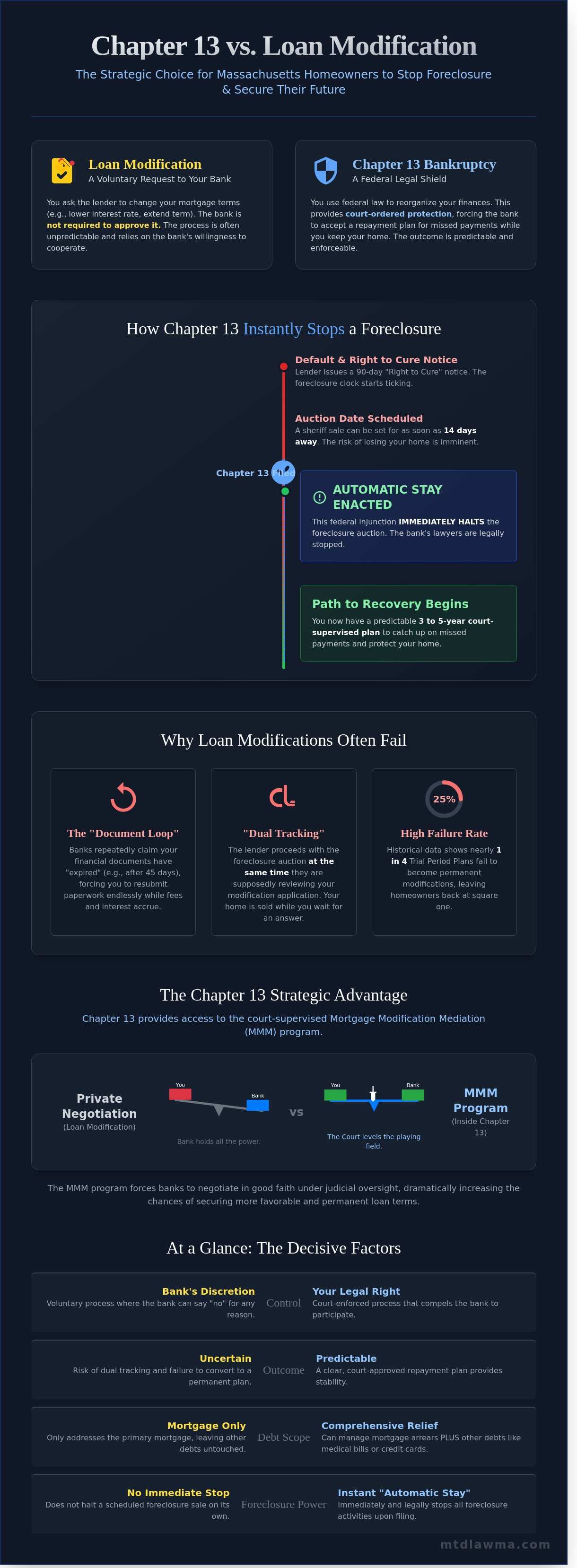
Immediate relief comes through the Automatic Stay. Filing for bankruptcy triggers this federal injunction, which halts a Reading sheriff sale immediately. It stops the bank's lawyers in their tracks. While a loan modification relies on the bank's willingness to cooperate, the stay is an absolute legal barrier that prevents the loss of your property while we build your case. This protection remains in place throughout the duration of your proceedings, ensuring that you aren't forced out of your home while seeking a resolution.
Deciding between these two paths requires a clear-eyed look at your financial goals. A loan modification seeks to change the existing contract, while a bankruptcy filing uses federal law to restructure your entire debt profile. We prioritize results-driven advocacy to ensure that whichever path you choose, your home remains secure.
Loan Modification: The Voluntary Approach
Banks often present loan modifications as the simplest path to recovery. This process involves negotiating with your lender to alter the original terms of your mortgage. Common changes include reducing an interest rate from 7% to 4.5% or extending a 30-year term to 40 years to lower the monthly obligation. However, the process is notoriously unpredictable. Many homeowners enter a Trial Period Plan (TPP), but historical data suggests that nearly 25% of these trials fail to convert into permanent modifications. You must remember that banks aren't legally required to grant you a modification. They're businesses focused on their bottom line, and they can deny your application for arbitrary reasons even after months of paperwork.
Chapter 13: The Legal Shield
Federal law provides a much more robust framework for saving your home. Chapter 13 Bankruptcy is a reorganization of your financial life that places you in the driver's seat. Instead of begging a lender for a modification, you propose a 3-to-5-year repayment plan to the court. This plan allows you to pay back mortgage arrears over 36 to 60 months while you continue making your regular monthly payments. It's a forced cure of the default. The power of a chapter 13 vs loan modification strategy lies in its predictability. Once the court approves your plan, the bank must accept the payments. They cannot proceed with a foreclosure as long as you adhere to the court-ordered schedule. This legal shield overrides local bank policies and provides a transparent, enforceable path to keeping your Reading home.
- Automatic Stay: Stops foreclosure auctions instantly upon filing.
- Repayment Term: 3 to 5 years to catch up on missed payments.
- Legal Authority: Federal courts oversee the process, not the bank's internal departments.
The Reality of Loan Modifications in Massachusetts: Why Banks Say No
Homeowners in Reading and throughout the North Shore often enter the loan modification process with a sense of cautious optimism. They believe that providing the requested financial data will lead to a fair resolution. Instead, many fall into the "Document Loop." This cycle involves submitting pay stubs and tax returns only to have the bank claim they expired after 45 days. The bank then requests the same documents again, stalling the process while interest and late fees continue to accrue. This administrative friction isn't just a nuisance; it's a barrier to stability.
Dual tracking remains a persistent threat despite state and federal regulations intended to curb the practice. This occurs when a lender moves forward with a foreclosure auction while simultaneously reviewing your application for assistance. You might receive a letter discussing a potential trial plan on Monday and a notice of sale on Tuesday. Understanding the Massachusetts loan modification process is essential to identifying these red flags early. Banks often prioritize their bottom line over your home equity, and their internal departments rarely communicate effectively.
The economic climate of 2026 has added a new layer of difficulty. With market interest rates projected to stay between 6.2% and 6.8%, lenders are less inclined to offer the 3% interest rate reductions that were common years ago. If your current mortgage is locked in at a historic low, a modification might actually increase your monthly payment or extend your term to 40 years just to make the numbers work. When weighing chapter 13 vs loan modification, you must consider whether the bank's "solution" actually provides long-term relief or simply kicks the crisis down the road.
Common Pitfalls of the Modification Process
Lenders use a "Net Present Value" (NPV) test to decide your fate. This proprietary formula compares the bank's projected profit from a modified loan against the immediate recovery from a foreclosure sale. If the numbers favor foreclosure by even a small margin, the bank will deny your request without explaining why. Another risk involves servicer transfers. Statistics show that roughly 18% of modification applications are lost or reset to zero when a mortgage is sold to a new company mid-review. Never make "good faith" payments without a signed Trial Period Plan. These payments are often diverted to "suspense accounts" and don't stop the foreclosure clock.
When a Modification Isn't Enough
A modification only addresses the mortgage. It does nothing for the $40,000 in high-interest credit card debt or the medical bills that triggered the financial crisis. Banks generally require a debt-to-income ratio of 31% for the housing payment alone. If your other monthly obligations exceed 15% of your gross income, the modification will likely fail within 12 months. For homeowners who are "underwater," where the mortgage balance is 110% of the home's value, a modification rarely offers the principal reduction needed for true solvency. In these complex scenarios, evaluating chapter 13 vs loan modification becomes a matter of survival. A denial isn't a dead end. It's often the signal that you need a more aggressive, court-enforced strategy. Consulting a strategic legal advocate can help you pivot from a position of defense to one of active protection.
Chapter 13 Bankruptcy: The Strategic Advantage for Essex and Middlesex Homeowners
When you're evaluating chapter 13 vs loan modification, the primary advantage of bankruptcy is the federal protection of the Automatic Stay. Under 11 U.S.C. § 362, the moment your petition is filed, all collection actions must stop. This isn't a request that a bank can ignore; it's a powerful court order. It halts foreclosure auctions, wage garnishments, and harassing phone calls immediately. For homeowners in Essex and Middlesex counties, this provides the breathing room needed to reorganize without the constant threat of losing their front door keys. The Consumer Financial Protection Bureau emphasizes several strategies for avoiding foreclosure, yet Chapter 13 remains the only path that grants you a legal right to a repayment plan regardless of the lender's internal policies.
The core distinction in the chapter 13 vs loan modification debate lies in the 60-month cure period. Chapter 13 allows you to take your total mortgage arrears and spread them across a five-year repayment plan. You simply resume your regular monthly mortgage payments and add a fraction of the past-due amount each month. This structure eliminates the uncertainty of bank negotiations. You aren't begging for a lower interest rate or a term extension that might never come. Instead, you're utilizing a federal statute to force a resolution that the bank is legally required to accept if it meets court standards.
Chapter 13 also serves as a critical shield for your assets. While a Chapter 7 filing might force the sale of non-exempt property to pay off creditors, Chapter 13 is designed to let you keep everything you own. This is vital for residents with significant home equity or personal property that exceeds Massachusetts state exemptions. By choosing this route, you're choosing to protect your legacy while systematically addressing your liabilities. It transforms a chaotic financial crisis into a disciplined, 60-month march toward total solvency.
The psychological relief of this process shouldn't be overlooked. Moving from the "whims" of a bank representative to a court-ordered plan changes the power dynamic in your favor. You're no longer waiting by the mailbox for a decision that might be a denial. You're working with a trustee and a judge who operate under transparent, predictable rules. This shift from reactive fear to proactive strategy is often the most significant benefit for our clients.
Lien Stripping: Removing Your Second Mortgage
In Massachusetts, Chapter 13 offers a unique tool called lien stripping. If your home's market value is less than what you owe on your first mortgage, the court can "strip" a second or third mortgage. In Reading, where property values are projected to stabilize by 2026, this timing is critical. If your home's appraisal shows the junior lien is "wholly unsecured," that second mortgage is reclassified as unsecured debt. By the end of your plan, that entire second mortgage is often discharged, potentially saving you six figures in long-term debt.
Managing Other Debts Alongside Your Mortgage
Your Chapter 13 plan doesn't just fix the house; it consolidates credit cards, medical bills, and tax debt into one manageable monthly payment. We apply the "Best Interests of Creditors" test to ensure your plan is legal. This test requires that your unsecured creditors receive at least as much as they'd get if your non-exempt assets were sold in a Chapter 7 case. Once you file, interest stops accruing on most unsecured debts, ensuring your payments actually reduce the principal balance. This comprehensive approach ensures that when your 60 months are up, you're completely debt-free and your mortgage is current.
The MMM Program: How Massachusetts Bankruptcy Courts Force Better Loan Terms
The Mortgage Modification Mediation (MMM) program is the most powerful tool available for Massachusetts homeowners facing foreclosure. While private negotiations often feel like shouting into a void, the MMM program brings the lender into a structured, court-supervised environment. This program isn't a request; it's a formal legal process where the U.S. Bankruptcy Court oversees the negotiation. When evaluating chapter 13 vs loan modification, the MMM program within a Chapter 13 filing offers the highest probability of success because it removes the bank's ability to ignore you. Since the program's adoption in the Massachusetts District, it has transformed how lenders handle distressed properties.
The "Portal" system serves as the backbone of this success. In a typical private modification, homeowners often resubmit the same 50 page packet three or four times because the bank claims they "lost" it. The MMM portal creates a permanent, transparent record of every document uploaded. This digital trail includes a specific date and time for every submission. If a bank claims they lack a document that we uploaded on June 12th, the mediator sees the evidence immediately. This accountability forces banks to act with a level of precision they rarely show outside of court. It eliminates the administrative "black hole" that ruins most private modification attempts.
A court-appointed mediator in the Reading area acts as a neutral referee during this process. They don't represent the bank, and they don't represent you; their job is to ensure both parties follow the rules. If a lender drags their feet or asks for redundant information, the mediator can report this behavior to the bankruptcy judge. This oversight is why the MMM program succeeds where private efforts fail. Lenders know that a judge can sanction them for bad faith negotiations, which gives them a massive incentive to offer fair terms.
The MMM Process Step-by-Step
We start by filing a Motion for Mediation immediately after your Chapter 13 petition is on the docket. Within 7 days of the court's approval, we upload your complete financial package to the portal. The lender must then designate a single point of contact with the legal authority to settle the case. You'll work with your Reading bankruptcy attorney to review the lender's counteroffers before attending the final mediation session. This session is led by the mediator who ensures the bank follows the mathematical formulas required by the program. Most cases reach a resolution within 90 to 120 days.
Why MMM is a Game-Changer for Foreclosure Defense
Success rates tell the real story. While private modification attempts often fail due to administrative errors, MMM programs across the country have shown that more than 60% of participants reach a permanent agreement. MTD Law leverages this system to secure interest rate reductions and principal re-amortization that lenders wouldn't offer voluntarily. We use the portal to trap lenders in their own timelines, ensuring your case moves toward a resolution. If you're tired of the bank's excuses, it's time to force them to the table. We've seen this process turn a 7% interest rate into a 4% rate for clients in similar situations. This isn't just about saving your home; it's about making your mortgage affordable for the next 30 years.
Stop the cycle of lost paperwork and start a court-ordered negotiation today. Contact MTD Law to begin your MMM application and secure your home's future.
Strategic Debt Relief at MTD Law: Protecting Your Future in Reading
Choosing the right legal path shouldn't feel like a gamble when your family home is on the line. In Reading, homeowners often find themselves caught in a difficult debate over chapter 13 vs loan modification because both options promise relief but deliver it through vastly different mechanisms. MTD Law provides the local insight necessary to navigate the Middlesex County court system and the U.S. Bankruptcy Court for the District of Massachusetts. We don't rely on generic templates; we build strategies based on the specific local rules that govern your neighborhood.
Our Reading experience matters because we understand the specific timelines used by regional lenders and the judges presiding over Eastern Division cases. We take a proactive stance to ensure your petition is filed with precision, effectively stopping the foreclosure clock before the auctioneer can arrive. By analyzing your unique financial landscape first, we identify the specific pressure points in your budget that a bank might ignore during a standard modification review. This meticulous preparation is what separates a temporary fix from a permanent solution.
Cost certainty is a cornerstone of our practice. We provide flat-fee bankruptcy services so you aren't surprised by hidden costs or hourly billing spikes during a crisis. You deserve to know exactly what your legal defense costs from day one. This transparency allows you to allocate your remaining resources toward your court-mandated repayment plan, ensuring you remain in compliance and on track to keep your property.
Your Consultation with Matthew T. Desrochers
Preparation is the first step toward regaining control. When you meet with Matthew T. Desrochers, you'll need to provide your tax returns from the last 2 years, pay stubs covering the most recent 6 months, and your latest mortgage statement. These documents allow us to perform a deep-dive analysis into your eligibility and debt-to-income ratio. We use this data to determine if chapter 13 vs loan modification is the superior route for your specific goals.
Our analytical process focuses on aggressive advocacy. We don't just wait for the bank to respond; we use federal law to demand protection. If a loan modification isn't in your best interest due to predatory terms or an unsustainable interest rate, we'll tell you directly. Our commitment is to your protection, not the lender's convenience. We serve as a stabilizing force, providing clear and strategic direction when you need it most.
Securing Your Reading Home for 2026 and Beyond
We look past the immediate crisis to ensure your home remains yours through 2026 and the decades that follow. A structured Chapter 13 repayment plan typically spans 36 to 60 months, providing a predictable roadmap to equity. This legal structure prevents lenders from changing the rules mid-stream, offering a level of security that informal negotiations simply cannot match. You'll have a court-ordered shield that protects your assets while you systematically eliminate your arrears.
Life after debt involves more than just keeping your keys; it requires a plan to rebuild your financial reputation. Most of our clients see a measurable improvement in their credit profile within 12 to 18 months of completing their plan, as the weight of past-due balances is lifted. We provide the guidance necessary to transition from insolvency to a position of strength. Contact MTD Law today to schedule your free foreclosure defense consultation and take the first step toward a secure future in Reading.
Secure Your Reading Home and Financial Future Today
Choosing between chapter 13 vs loan modification represents a critical turning point for your family's stability. While banks frequently deny modification requests to prioritize their bottom line, Chapter 13 bankruptcy provides a powerful federal injunction that halts foreclosure sales instantly. Since 2008, MTD Law has guided homeowners throughout Essex and Middlesex Counties by leveraging the Massachusetts Bankruptcy Court's Mortgage Modification Mediation (MMM) program. This specific legal tool forces lenders to negotiate in good faith under judicial oversight, giving you a seat at the table they can't ignore.
You don't have to navigate these high-stress proceedings without a dedicated protector. Attorney Matthew T. Desrochers delivers direct advocacy for every case, ensuring your rights remain the priority. We provide clear, flat-fee bankruptcy filing options to eliminate financial uncertainty during your recovery. Our firm has spent over 15 years refining strategies that preserve homeownership and resolve overwhelming debt. Your residence is your most important investment; it deserves a sophisticated defense.
Schedule Your Free Consultation with a Reading Foreclosure Defense Attorney to begin your recovery. There's a proven way forward, and we're ready to help you find it.
Frequently Asked Questions
Can I file for Chapter 13 if my loan modification was already denied?
You can file for Chapter 13 even if your lender previously denied your loan modification request. Bankruptcy operates under federal law, specifically Title 11 of the U.S. Code, which overrides a bank's internal debt-to-income requirements. While a bank might reject you for failing their 31 percent debt-to-income ratio test, a Chapter 13 plan allows you to cure arrears over a 60 month period regardless of that specific bank metric.
How long does the automatic stay protect my Reading home after filing?
The automatic stay protects your Reading home the instant your attorney files the petition with the U.S. Bankruptcy Court for the District of Massachusetts. This legal shield typically remains in place for the entire 36 to 60 month duration of your repayment plan. As long as you maintain your post-petition mortgage payments, the stay prevents the lender from initiating or continuing any collection actions against your property.
Will filing for bankruptcy stop a foreclosure auction scheduled for tomorrow?
Filing for bankruptcy stops a foreclosure auction scheduled for tomorrow as long as the petition is filed before the auctioneer concludes the sale. Under 11 U.S.C. § 362, the automatic stay takes effect immediately upon filing. Our firm has seen clients halt sales scheduled for 10:00 AM by filing at 9:00 AM. This provides a critical window to reorganize your finances and save your equity.
What is the MMM program in the Massachusetts Bankruptcy Court?
The MMM program is the Mortgage Modification Mediation program designed to facilitate communication between borrowers and lenders under court supervision. Massachusetts adopted this program in 2013 to address the high failure rate of private negotiations. It requires lenders to use a secure online portal, which ensures that 100 percent of your submitted documents are tracked and reviewed by a neutral mediator rather than lost in a corporate mailroom.
Is it possible to do a loan modification while inside a Chapter 13 plan?
It's entirely possible to secure a loan modification while you're inside a Chapter 13 plan. In fact, when comparing chapter 13 vs loan modification, many homeowners find that the court-supervised MMM program is more effective than applying on their own. The bankruptcy court provides a structured environment where the lender must respond to your application within 30 days, preventing the common excuses that often stall private negotiations.
How much does a Chapter 13 lawyer cost in Essex County?
In Essex County, Chapter 13 legal fees are often governed by "no-look" fee guidelines established by the local bankruptcy court. Most experienced attorneys charge between $4,500 and $6,000 for a standard case. You don't have to pay this entire amount upfront. A portion is typically paid before filing, while the remaining balance is built into your monthly Chapter 13 plan payments over the next five years.
What happens to my credit score if I choose Chapter 13 over a modification?
Your credit score will likely drop by 100 to 200 points immediately after filing for Chapter 13, but it often recovers faster than a series of missed payments. A Chapter 13 filing remains on your credit report for 7 years from the filing date. When evaluating chapter 13 vs loan modification, remember that a modification also impacts your score if the lender reports the account as "settled for less than the full balance."
Can I keep my car if I file for Chapter 13 in Massachusetts?
You can keep your car in a Massachusetts Chapter 13 filing by using state or federal exemptions to protect your equity. Under Massachusetts General Laws Chapter 235, Section 34, you can exempt up to $7,500 in equity in a single vehicle, or up to $15,000 if you're over age 60 or disabled. If your car equity exceeds these limits, you simply pay the non-exempt portion through your 60 month repayment plan.

Comments
There are no comments for this post. Be the first and Add your Comment below.
Leave a Comment