
Massachusetts Personal Injury Statute of Limitations: A Reading MA Guide (2026)

The most critical factor in your legal recovery isn't the strength of your evidence, it's the date on your calendar. If you miss the massachusetts personal injury statute of limitations, even a clear-cut case for compensation becomes legally void. We know the stress of managing physical therapy while bills from local providers like Winchester Hospital continue to arrive. You likely feel that the law should prioritize your physical healing over rigid paperwork deadlines; however, the court's timeline remains unforgiving as we move through 2026.
This guide ensures you master the strict deadlines governing your claim so your right to a settlement remains protected. You'll gain a clear understanding of the standard three year filing window and how specific factors can extend your timeline. We also provide the exact local details you need for filing within the Middlesex County court system to secure your financial future. By the time you finish reading, you'll have a strategic roadmap to move your case forward with the disciplined precision your recovery deserves.
Key Takeaways
- Understand the standard three-year window under state law and why the exact date of your injury serves as the critical starting point for your claim.
- Discover how legal "tolling" and the Discovery Rule may adjust the massachusetts personal injury statute of limitations when injuries are not immediately apparent.
- Avoid the "2-Year Presentment Trap" by mastering the unique, shorter deadlines required for claims involving government entities in Reading and Middlesex County.
- Determine the proper court jurisdiction for your filing to ensure your case proceeds efficiently through the local Woburn or Middlesex County legal systems.
- Learn how proactive legal advocacy protects your long-term interests through contingency-based representation that prioritizes your recovery over legal fees.
The 3-Year Rule: Understanding the Massachusetts Personal Injury Statute of Limitations
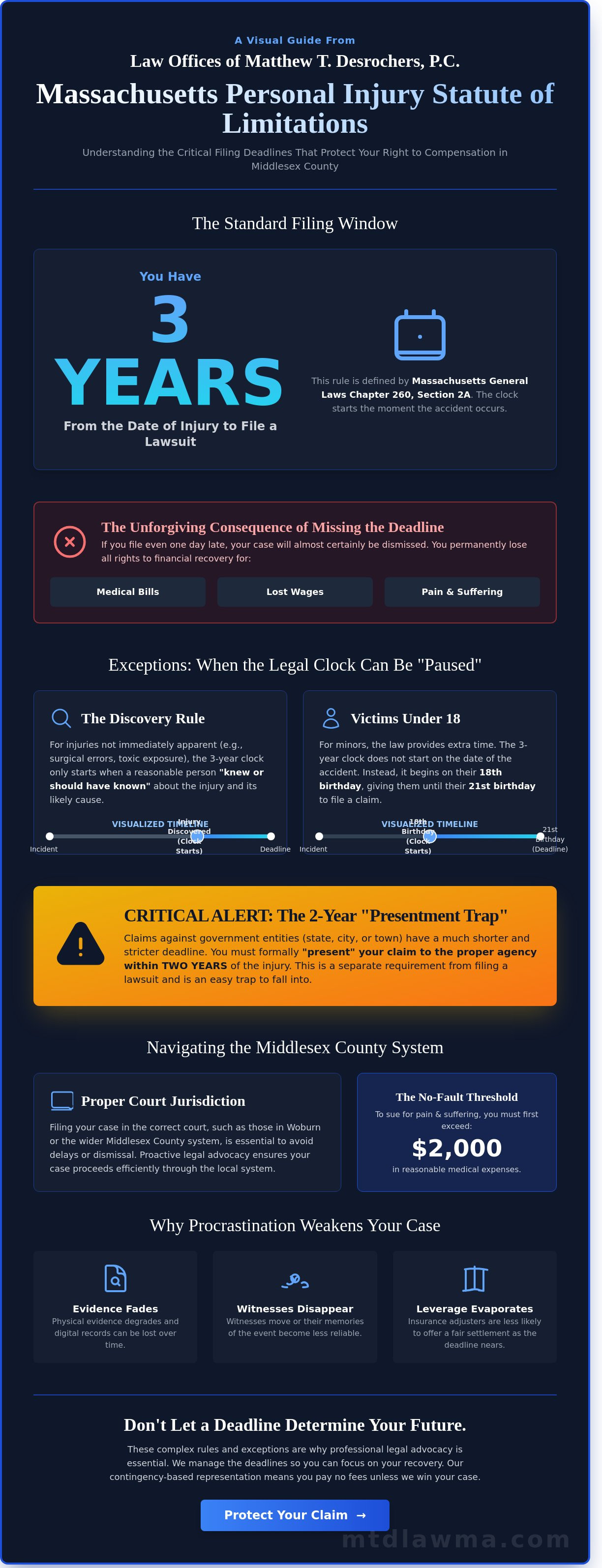
In Massachusetts, the clock starts ticking the moment an accident occurs. Under Massachusetts General Laws Chapter 260, Section 2A, victims generally have three years from the date of the incident to file a lawsuit. This timeline is known as the statute of limitations. It serves as a strict procedural boundary for your recovery. For Reading residents, it's vital to distinguish this from a statute of repose. While the limitation period starts at the injury, a statute of repose sets a hard cap on claims regardless of when the harm was discovered, often appearing in construction or medical malpractice contexts.
Waiting until the final month to seek counsel isn't a strategic move. Evidence fades. Witnesses move away. Your leverage in negotiations evaporates as the deadline nears. We treat the massachusetts personal injury statute of limitations as a hard deadline that requires early preparation to ensure all evidence is preserved and your rights are fully protected. Early intervention allows us to build a comprehensive case file while the details of the incident remain fresh.
The No-Fault Threshold and Filing Deadlines
Reading residents navigate a no-fault insurance system that impacts how and when they can file suit. You first look to your own Personal Injury Protection (PIP) benefits for immediate relief. However, you can't sue the at-fault driver for pain and suffering unless you meet the $2,000 medical expense threshold. We monitor your medical billing closely to ensure you meet these requirements. Don't let the massachusetts personal injury statute of limitations slip away while you're still receiving PIP benefits. If your treatment plan is ongoing, we ensure your filing happens before the three-year mark, even if you haven't reached a point of maximum medical recovery.
Consequences of Missing the Deadline
The legal system offers very little mercy for those who miss a filing window. If you file even one day late, the defendant's attorney will likely file a Motion to Dismiss. Judges rarely grant exceptions to these statutory rules. A dismissal means your claim is permanently barred. You lose the right to seek financial recovery for medical bills, lost wages, or emotional distress. Beyond the courtroom, a looming deadline weakens your position during insurance settlement talks. Adjusters know that if you can't sue, they don't have to pay. Securing your future requires proactive movement long before the clock runs out.
Exceptions and Tolling: When the Legal Clock Starts Later
While the standard three-year window applies to most claims, the law recognizes that justice requires flexibility in specific circumstances. Tolling acts as a legal pause button on the countdown for a massachusetts personal injury statute of limitations claim. It ensures that victims aren't barred from seeking compensation simply because they couldn't physically or legally file a lawsuit within the typical timeframe. This mechanism is vital for maintaining the integrity of the legal process in Reading, as it prevents the clock from running against those who are unable to protect their own interests. The legal basis for these time limits is found in Massachusetts General Laws, Chapter 260, Section 2A, which sets the foundational requirements for filing personal injury actions.
The Discovery Rule in Latent Injury Cases
In many scenarios, the harm isn't immediately obvious. A patient might undergo surgery on May 15, 2021, but only discover a surgical error in 2024 when chronic pain develops. Similarly, toxic exposure cases often involve illnesses that remain dormant for years. Massachusetts judges apply the "knew or should have known" standard to these situations. This means the clock only starts when a reasonable person would have recognized the injury and its likely cause. Under the Discovery Rule as it pertains to MGL Ch. 260, the limitations period is stayed until the plaintiff possesses sufficient knowledge to connect their harm to the defendant's actions.
Minors and the Tolling Statute
The Commonwealth provides significant protections for victims under the age of 18. For minors, the three-year clock typically begins on their 18th birthday rather than the date of the accident. This gives them until their 21st birthday to initiate litigation. However, waiting over a decade to file a claim is rarely advisable. Evidence disappears and witnesses move away. Proactive parents often choose to seek strategic legal guidance early to preserve the integrity of the case. It's also important to note that settlements involving minors often require approval from the Middlesex County Probate and Family Court to ensure the child's long-term financial security.
Tolling also applies to individuals suffering from mental disabilities or legal incapacity at the time of their injury. If a person is unable to understand their legal rights or manage their affairs, the law pauses the statute of limitations until the disability is removed. This protection serves as a vital safeguard for the most vulnerable members of the community, ensuring they aren't denied a voice in the legal system due to circumstances beyond their control. This nuance is why understanding the specific application of the massachusetts personal injury statute of limitations is essential for any potential claimant. Our firm acts as a stabilizing force, ensuring that these technical exceptions are utilized to protect your right to recovery.
Claims Against the Government: The 2-Year Presentment Trap
While the standard massachusetts personal injury statute of limitations provides a three-year window for most civil actions, cases involving public entities operate under a much tighter timeline. Under Massachusetts General Laws Chapter 258, also known as the Tort Claims Act, any individual seeking damages from the Commonwealth, Middlesex County, or the Town of Reading must navigate the presentment requirement. This isn't merely a suggestion; it's a mandatory procedural hurdle that requires you to formally notify the executive officer of the public employer within two years of the incident.
A valid presentment letter must be meticulously drafted. It needs to include a clear statement of the facts, the nature of the claim, and a specific demand for damages. If your letter is sent to the wrong department or fails to include required details, the court may dismiss your case entirely. While there are Exceptions to the Rule regarding certain tolling provisions, these rarely apply to the strict two-year presentment deadline. Missing this window effectively bars you from ever recovering compensation for your injuries. We ensure every document meets the strict statutory demands of MGL Chapter 258 to protect your right to advocacy.
Suing the Town of Reading or Local Agencies
If you suffer a slip and fall on a broken sidewalk on Haven Street or a collision with a Reading municipal vehicle, the Town of Reading is your target defendant. You must deliver your presentment letter to the Select Board or the Town Counsel. Once the town receives this notice, a mandatory six-month waiting period begins. You can't file a formal lawsuit in court until the town denies the claim in writing or the six months expire. Filing prematurely often leads to an immediate dismissal of your case by the court.
MBTA and State Agency Deadlines
Accidents involving the MBTA Commuter Rail, which serves the Reading station on the Haverhill Line, follow specific state-level protocols. State agencies enjoy a degree of sovereign immunity, which is only partially waived if you follow every procedural step perfectly. You must distinguish between the Notice of Claim deadline and the final massachusetts personal injury statute of limitations for filing the actual suit. The two-year notice requirement is a trap that catches many unrepresented plaintiffs. Our firm acts as a stabilizing force, providing the clear, strategic direction needed to hold state agencies accountable for their negligence.
Navigating the Filing Process in Reading and Middlesex County
Filing a lawsuit involves more than just beating the clock. You must initiate the process correctly to preserve your rights under the massachusetts personal injury statute of limitations. Commencing an action begins with filing a formal complaint and paying the required filing fee at the appropriate courthouse. In Massachusetts, you must then complete "service of process" on the defendant. This step requires a sheriff or constable to deliver the summons and complaint within 90 days of the initial filing. Failing to meet this secondary deadline can lead to a dismissal, even if you filed the original paperwork on time. Our firm manages these procedural hurdles to ensure your case moves forward without delay.
District Court vs. Superior Court for Reading Residents
Reading residents typically resolve disputes within the Middlesex County court system. The specific venue depends on the "amount in controversy," which is the total value of your financial damages. We analyze your medical bills, lost wages, and pain and suffering to determine the correct jurisdiction.
- Woburn District Court: This court handles claims where damages are $50,000 or less. It's located at 30 Pleasant Street in Woburn. It's a common venue for minor motor vehicle accidents or premises liability cases with limited injuries.
- Middlesex Superior Court: For serious injuries where damages exceed $50,000, you'll file here. The court is located at 200 Trade Center in Woburn, though some Middlesex matters are handled at the Lowell session at 360 Gorham Street.
Practical tip: If you're visiting the Woburn District Court, arrive before 8:30 AM. The local parking lot fills quickly, and street parking in the surrounding neighborhood is strictly regulated.
Gathering Evidence Before the Clock Runs Out
The three year window provided by the massachusetts personal injury statute of limitations feels long, but evidence disappears quickly. You need to secure documentation while it's fresh to build a formidable case. We prioritize the immediate collection of local records to anchor your claim in facts.
- Police Reports: Visit the Reading Police Department at 15 Union Street to obtain official accident reports. These documents often contain officer observations and witness contact information that becomes harder to find as years pass.
- Medical Records: Request your charts from Winchester Hospital or local Reading clinics immediately. Treatment notes from the hours following an accident are vital for proving the direct cause of your injuries.
Witness memories often begin to fade within months, and physical evidence like skid marks or property damage can be cleared in days. Proactive evidence collection ensures your case remains strong through the litigation process. We act as your protector, securing this data before it's lost to time.
Protecting Your Future: Why Professional Advocacy is Essential
Legal crises in Reading create immediate chaos for families. The Law Offices of Matthew T. Desrochers, P.C. acts as a stabilizing force, providing clear, strategic direction when the massachusetts personal injury statute of limitations begins its countdown. Our firm operates on a contingency-fee basis, meaning you don't pay upfront costs or hourly rates. We only collect a fee if we secure a settlement or verdict for your case. This structure ensures every Reading resident has access to high-caliber legal protection regardless of their current financial standing. We prioritize your recovery while we handle the complex logistics of your claim.
Insurance companies often use the three-year deadline as a tactical weapon. They may delay communications or request redundant documentation to push you closer to the expiration date. Once that window closes under Massachusetts General Laws Chapter 260 Section 2A, your right to recover damages vanishes. A proactive attorney shuts down these tactics by filing necessary legal documents well before the deadline. We focus on results in Middlesex County, ensuring your claim remains active and prioritized by the court system. Our team possesses the analytical sharpness required to counter aggressive defense strategies effectively.
Strategic Direction and Early Intervention
Retaining counsel immediately after an injury is vital for evidence preservation. Physical evidence at a crash site on Main Street or Haven Street can disappear within 48 hours. We work to secure surveillance footage and expert testimony before memories fade or scenes change. Insurance adjusters treat claims with greater urgency when they see the Law Offices of Matthew T. Desrochers, P.C. involved early in the process. Our commitment to aggressive advocacy means we don't wait for the insurer to act; we set the pace of the litigation to ensure a timely resolution for Reading families.
Your Free Consultation in Reading, MA
Every injury case has unique variables that can alter the filing timeline. Our team provides a no-obligation case review to calculate your specific deadline with precision. We are deeply integrated into the Massachusetts legal landscape and understand the local court procedures that impact your recovery. Don't let the clock run out on your right to justice. Secure your future with a free personal injury consultation and let us provide the formidable protection your family deserves. Our goal is to move your case from a state of uncertainty to a successful resolution.
Secure Your Recovery Before Time Expires
Navigating the massachusetts personal injury statute of limitations requires more than just marking a calendar. While the standard 3-year window applies to most claims, the 2-year presentment requirement for government-related incidents creates a narrow path for recovery. Missing these rigid deadlines can permanently bar your right to seek compensation. Attorney Matthew T. Desrochers has spent over 15 years deeply integrated into the Middlesex County legal landscape, providing the strategic direction needed to manage complex filing requirements in Reading and surrounding areas.
Protecting your future starts with proactive advocacy. MTD Law operates on a contingency-based fee structure; you pay nothing unless we win your case. This commitment ensures you receive results-driven representation without immediate financial strain. Every day you wait is a day that evidence can fade or legal windows can close. Don't let a procedural error derail your path to justice; instead, rely on a partner who understands the local courts and the stakes involved.
Contact MTD Law today for a free evaluation of your Reading personal injury claim.
We're ready to help you move forward with confidence and clarity.
Frequently Asked Questions
Is the statute of limitations different for a car accident in Reading vs. a slip and fall?
No, the massachusetts personal injury statute of limitations applies a uniform 3-year deadline to both car accidents and slip and fall incidents. Under Massachusetts General Laws Chapter 260 Section 2A, you have exactly 3 years from the date of the occurrence to file a lawsuit in court. This timeline ensures that evidence remains fresh and witnesses are available. Missing this deadline results in a permanent loss of your right to seek compensation.
Can I still file a personal injury claim if I was partially at fault for the accident?
You can still file a claim if your level of fault doesn't exceed 50 percent. Massachusetts follows a modified comparative negligence rule under Chapter 231 Section 85. If a jury determines you're 20 percent responsible for a collision on Main Street, your final recovery decreases by that same 20 percent. However, if your fault reaches 51 percent, the law bars you from recovering any damages from other parties.
What happens if the person who injured me leaves the state of Massachusetts?
The 3-year clock pauses if the defendant leaves the state before you can file your lawsuit. According to Massachusetts General Laws Chapter 260 Section 9, the time they spend living outside the Commonwealth doesn't count toward the statute of limitations. This legal protection prevents negligent parties from escaping accountability by simply moving across state lines. We track these residency changes to ensure your right to litigation remains protected throughout the process.
How does the statute of limitations work for a wrongful death claim in Reading?
Wrongful death claims in Reading must be filed within 3 years of the date of death. Massachusetts General Laws Chapter 229 Section 2 dictates this timeline for the executor or administrator of the deceased person's estate. In specific cases where the cause of death wasn't immediately apparent, the 3-year period begins when the executor knew or should've known the cause. This strict window requires immediate strategic action to preserve vital evidence.
Does the 3-year limit apply to property damage claims as well as physical injuries?
Yes, property damage claims also carry a 3-year statute of limitations in Massachusetts. Whether you're seeking repairs for a vehicle damaged near the Reading train station or replacement of personal items, you must initiate legal action within 3 years of the incident. This deadline is separate from your physical injury claim, though they often proceed together. Filing after this 1,095-day window typically leads to an immediate dismissal by the court.
What is the "presentment" rule for claims against the Town of Reading?
The presentment rule requires you to provide formal written notice to the Town of Reading within 2 years of the injury. Under the Massachusetts Tort Claims Act, Chapter 258, this notice is a mandatory precursor to filing a lawsuit against any municipal entity. Failing to serve this specific legal document to the correct town official within 730 days will permanently bar your claim. This rule is significantly shorter than the standard 3-year litigation deadline.
Can an insurance company extend the statute of limitations during negotiations?
No, an insurance company doesn't have the legal authority to extend the statute of limitations. Adjusters might continue negotiations for 36 months, but these discussions don't pause the legal clock. If the 3-year deadline passes without a filed lawsuit, the insurance company will likely cease all settlement offers because you've lost your legal leverage. We monitor these dates meticulously to ensure negotiations don't compromise your right to trial.
Does filing an insurance claim count as "filing a lawsuit" for the 3-year deadline?
Filing an insurance claim is not the same as filing a lawsuit in the Massachusetts court system. To satisfy the massachusetts personal injury statute of limitations, your attorney must file a formal complaint in a court like Middlesex Superior Court before the 3-year mark. Simply opening a claim with a provider like GEICO or Progressive doesn't stop the clock. Only a court filing provides the legal protection necessary to keep your case active.

Comments
There are no comments for this post. Be the first and Add your Comment below.
Leave a Comment