
Qualifying for Debt Relief: The Reading MA Chapter 7 Means Test Guide (2026)

This guide provides the strategic direction you need to determine your eligibility with certainty. You'll learn exactly how the 2026 means test functions and discover legal methods to lower your disposable income through allowable deductions. We'll also explain why partnering with a local Reading attorney is the most effective way to handle these complex calculations. Our goal is to replace your anxiety with a clear, results-oriented plan for debt resolution and long-term financial stability.
Key Takeaways
- Understand how the 2026 Massachusetts median income thresholds and your household size establish the foundation for your Chapter 7 eligibility.
- Learn the strategic methods used to pass the chapter 7 means test massachusetts even if your earnings are above the median by utilizing specific legal deductions.
- Discover why timing your filing around the six-month lookback period is a critical tactical move for those with fluctuating income or recent job changes.
- Recognize the risks of self-filing and how professional legal guidance in Reading serves as a formidable shield against the high rate of case dismissals.
- Gain a clear, results-driven perspective on how the federal means test formula determines your path toward long-term financial stability and protection.
Understanding the Chapter 7 Means Test in Reading, Massachusetts
The means test serves as a critical gateway in the federal bankruptcy system. It's a structured formula designed to prevent high-income earners from filing for Chapter 7 relief if they possess the financial capacity to repay their debts. For residents in Reading, this calculation determines whether you qualify for a total discharge of unsecured debts through liquidation or if you must enter a Chapter 13 repayment plan. The chapter 7 means test massachusetts focuses specifically on your "disposable income," which is the money remaining after paying necessary monthly expenses. This test only applies to individuals whose financial obligations are primarily consumer debts, such as credit cards, medical bills, or personal loans.
The Two Stages of the Massachusetts Means Test
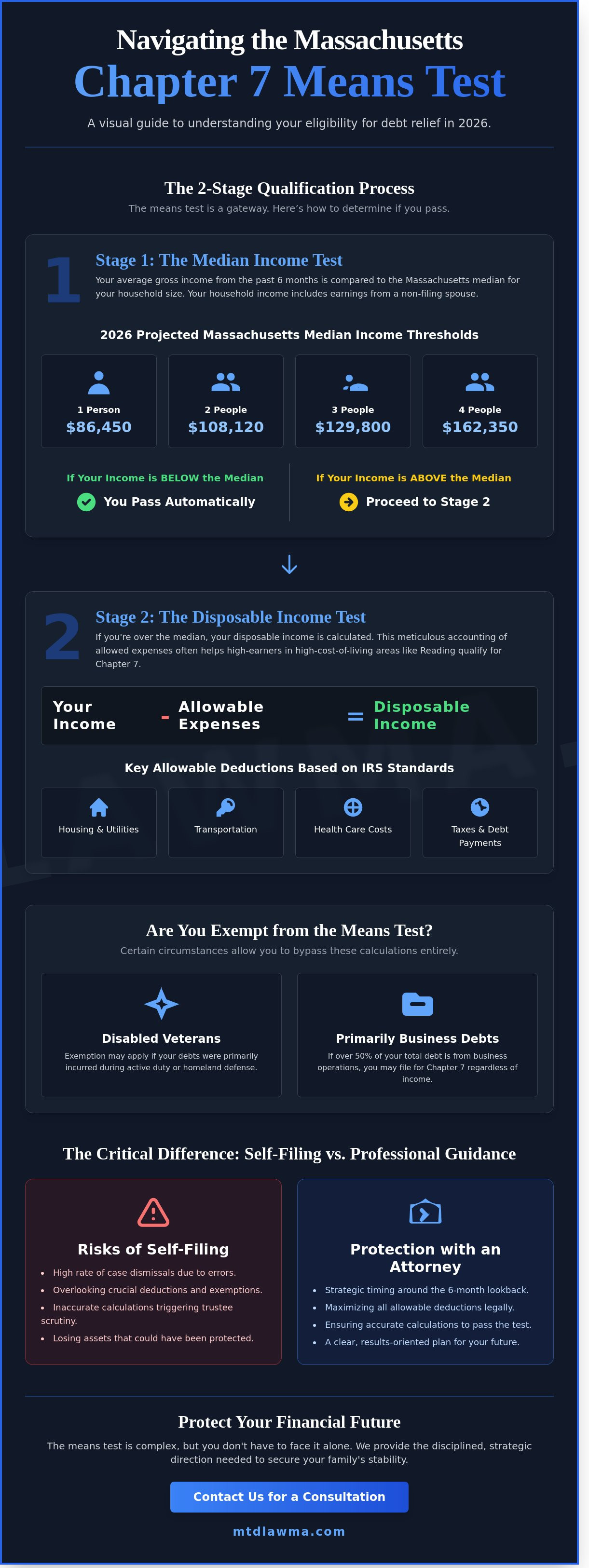
Stage one involves a direct comparison of your household's average gross income over the last six months against the Massachusetts state median income. These figures are updated periodically by the U.S. Census Bureau; the most recent adjustments typically occur on April 1 and November 1 each year. If your income falls below the median, you pass automatically. If it exceeds the median, you move to stage two. This second stage is a meticulous accounting of allowed expenses. Reading residents often face a high cost of living in Middlesex County. The chapter 7 means test massachusetts accounts for this by allowing deductions for housing, utilities, and transportation based on IRS National and Local Standards. High earners in Reading frequently qualify for Chapter 7 because their actual, necessary costs offset their higher gross income.
Who is Exempt from the Means Test?
Certain individuals bypass these calculations entirely. Disabled veterans whose debts were incurred primarily during active duty or homeland defense are often exempt. Additionally, the test doesn't apply if your debts are not primarily consumer-based. If more than 50% of your total debt stems from business operations, you may file for Chapter 7 regardless of your personal income levels. This exemption provides a vital path for Reading business owners who have personally guaranteed commercial leases or equipment loans. MTD Law provides the strategic direction needed to identify these exemptions early in the process. We focus on protecting your financial future by ensuring every deduction is captured accurately. Our firm acts as a stabilizing force, moving you toward a resolution with disciplined precision.
Massachusetts Median Income Thresholds for 2026
The first step in qualifying for debt relief involves comparing your total household income against the state's median levels. These thresholds are not static; the U.S. Census Bureau and the Department of Justice update this official median income data twice each year, typically in April and November. For residents in Reading and throughout the Commonwealth, these figures serve as the primary benchmark for the chapter 7 means test massachusetts requires. If your income falls below the median for a household of your size, you generally qualify for Chapter 7 protection without further complex calculations.
Your "household income" includes every dollar brought into the home. This includes the earnings of a non-filing spouse, even if they aren't joining the bankruptcy petition. We analyze these figures with a focus on precision, ensuring every source of revenue is accounted for to prevent challenges from the U.S. Trustee. The following table provides projected median income figures for 2026 based on recent economic trends in the Massachusetts region.
| Household Size | Annual Income Threshold (Projected 2026) |
|---|---|
|
1 Person |
$86,450 |
|
2 People |
$108,120 |
|
3 People |
$129,800 |
|
4 People |
$162,350 |
Calculating Your "Current Monthly Income" (CMI)
The chapter 7 means test massachusetts relies on your Current Monthly Income, which is a specific average of your earnings over the last 180 days. This 6-month lookback rule captures every cent earned, including gross wages, performance bonuses, rental income, and even regular financial contributions from family members. We exclude Social Security benefits from this calculation, as federal law protects these funds from being used to determine bankruptcy eligibility. Our team meticulously reviews your pay stubs and bank statements to establish an accurate CMI, providing a clear path toward your financial recovery. If you're unsure how your specific earnings impact your filing, consulting with a local attorney can provide the clarity you need.
Defining "Household Size" in Reading MA
Determining who counts as a household member is vital for your filing strategy. While many courts use the "heads in beds" rule, which counts anyone living in the home, others apply the "economic unit" definition. This distinction is crucial for Reading families managing multi-generational households or supporting children away at college. If you provide more than half the support for an elderly relative or a student, they may be included in your household size even if they don't reside in your home year-round. We evaluate shared expenses and financial dependencies to ensure your household size is maximized, which often helps higher-earning individuals pass the means test and secure the debt discharge they deserve.
What If Your Income Exceeds the Massachusetts Median?
Earning more than the median income for a household of your size in Massachusetts creates a legal hurdle, but it doesn't close the door on debt relief. When your income sits above the threshold, the court applies a secondary, more rigorous calculation. This phase determines if a "presumption of abuse" exists. The legal system assumes that high-earners possess the "disposable income" necessary to fund a Chapter 13 repayment plan. To secure a discharge under Chapter 7, we must rebut this presumption by proving that your necessary living costs leave no surplus for creditors. This is a critical component of the Chapter 7 means test, where strategic advocacy becomes your strongest asset. Many Reading residents successfully qualify even with high salaries because their actual, allowable expenses are equally high.
Allowed Expense Deductions in the Means Test
The IRS provides specific National and Local Standards that serve as the benchmark for this analysis. For residents in Reading, we utilize the Middlesex County housing and transportation allowances. These figures reflect the high cost of living in our specific region. Beyond these standard allowances, we deduct mandatory payroll taxes, health insurance premiums, and required retirement contributions. High-priority secured debts play a pivotal role. Your monthly mortgage payment and car loans are deducted from your gross income to provide a realistic picture of your financial capacity. Successfully passing the chapter 7 means test massachusetts requires a meticulous accounting of every dollar that leaves your household for essential needs. We don't just look at the averages; we focus on the specific financial obligations that define your life.
Special Circumstances and Additional Deductions
The law recognizes that financial life isn't always standard. We often identify additional deductions that help clients qualify. If you pay for childcare so you can work, those costs are fully deductible. Private school tuition may also qualify if it's necessary for a child with physical or mental disabilities. Charitable contributions to Reading-area nonprofits or religious organizations are protected, provided they don't exceed 15% of your gross income. We also account for the ongoing costs of caring for elderly or chronically ill family members. These specific, documented expenses often bridge the gap between an initial presumption of abuse and a successful Chapter 7 filing. Our firm focuses on these granular details to protect your right to a fresh start. We treat every deduction as a tool for your future stability.
Strategic Timing: How the 6-Month Lookback Affects Your Filing
The success of a chapter 7 means test massachusetts filing often depends on the calendar. Bankruptcy law calculates your income based on a specific lookback period, which is defined as the six complete calendar months prior to the month you file your petition. This six-month window creates a "Current Monthly Income" (CMI) average that determines your eligibility. If you earned a significant year-end bonus or worked high-paying overtime in Reading's tech or healthcare sectors, those spikes can artificially inflate your average and push you over the median income threshold. We strategically analyze your pay cycles to ensure your petition reflects a sustainable financial reality rather than a temporary high point.
The "Snapshot" Problem
Your filing date acts as a shutter release on a camera. If you file on October 31, the court looks at income from April through September. Filing on November 1 shifts that window to include October and drop April from the calculation. This 24-hour difference can be the deciding factor if April was a high-earning month due to seasonal commissions or a tax refund. For residents in the Reading area, gathering 180 days of pay stubs and bank statements is the first step in our legal review. We analyze these documents to identify the precise moment when your six-month average is at its lowest. Timing the filing to drop a high-earning month is a legitimate strategy, but it requires meticulous planning. You shouldn't attempt to manipulate income through bad faith actions, such as voluntarily quitting a job or refusing a promotion just to qualify. Massachusetts trustees scrutinize sudden income drops closely to ensure the system isn't being exploited.
Rebutting the Presumption of Abuse
If your income exceeds the state median, the court may presume that filing for Chapter 7 is an abuse of the system. This isn't an automatic disqualification. We can rebut this presumption by providing evidence of special circumstances that justify higher expenses or a lower future income. A Reading MA attorney drafts a formal statement of special circumstances to explain why the 6-month average doesn't reflect your current reality. For example, if a 15% reduction in force at a local firm impacted your household, or if you're facing $8,500 in non-reimbursable medical costs, these facts matter. The U.S. Trustee reviews these over-median cases with a critical eye, so your evidence must be documented and undeniable. We focus on providing the clarity needed to secure your financial future.
Navigating the Reading MA Bankruptcy Process with MTD Law
Understanding the theory behind the chapter 7 means test massachusetts is the first step, but applying that math to your specific financial situation requires precision. Filing for bankruptcy is a technical process where a single clerical error can lead to a case dismissal. Data from the United States Courts indicates that pro se filers face significantly higher hurdles; in some jurisdictions, the success rate for unrepresented debtors is less than 10% compared to those with legal counsel. At MTD Law, we transform complex legal requirements into a clear roadmap for our clients.
Our Reading office serves as a strategic hub for residents across Essex and Middlesex counties. We don't just fill out forms. Instead, we advocate for your right to a fresh start by ensuring every deduction allowed under the chapter 7 means test massachusetts is utilized. This proactive approach protects your assets and minimizes the risk of a U.S. Trustee challenge. Our team handles the heavy lifting of document preparation so you can focus on your family and your future.
Local Representation in the Middlesex County Courts
Legal proceedings are rarely anonymous. Local bankruptcy trustees in the Middlesex County area have specific expectations regarding documentation and financial transparency. Our presence in Reading gives us a distinct advantage; we understand the local financial landscape and the nuances of the regional court system. We prepare you thoroughly for the Meeting of Creditors, also known as the 341 Meeting. This preparation ensures you walk into the room with confidence, knowing your counsel has vetted every detail of your petition. We anticipate the questions trustees ask and address potential red flags before they become obstacles.
Your Path to a Fresh Financial Start
The ultimate objective of our partnership is a total discharge of qualifying unsecured debts. This legal release frees you from the burden of credit card balances, medical bills, and personal loans. We manage the intricate paperwork and court deadlines while you reclaim your peace of mind. Taking the first step is often the hardest part of the journey. We invite you to schedule your free Reading MA consultation today. Let us run the means test math for you and determine the most effective strategy for your financial recovery.
Take Control of Your Financial Future in Reading
Navigating the chapter 7 means test massachusetts requires more than a simple calculation of your current monthly wages. Success depends on a precise analysis of the 2026 median income thresholds and a strategic evaluation of your 6-month lookback period. Since 2008, MTD Law has delivered the disciplined precision needed to turn these complex legal requirements into a clear path toward debt relief. We've spent nearly two decades serving the Reading community and neighbors throughout Middlesex and Essex counties. This local experience ensures every filing is timed for maximum effectiveness. You don't have to navigate this high-stress process without a formidable protector by your side. Our firm pairs aggressive advocacy with transparent, flat-fee bankruptcy services to provide the stability you deserve. We focus on results-driven solutions that bridge the gap between your current hardship and a secure financial horizon. Secure your financial future with a free Reading MA bankruptcy consultation and begin your journey toward lasting peace of mind. It's time to leave the weight of debt behind and start your next chapter with confidence.
Frequently Asked Questions
Is the Chapter 7 means test different in Massachusetts than in other states?
Yes, the income thresholds for the means test are specific to each state and household size. Massachusetts currently has some of the highest median income limits in the United States. For a single-person household in the Commonwealth, the median income limit as of November 1, 2023, is $82,903. These figures are updated twice each year by the U.S. Census Bureau to reflect regional economic shifts.
What happens if I fail the Chapter 7 means test in Reading?
You can still pursue debt relief through Chapter 13 bankruptcy if your income exceeds the state median. Failing the test implies you have enough disposable income to repay a portion of your debts over a five-year period. In 2023, approximately 25% of bankruptcy filers nationwide utilized Chapter 13. This path allows you to protect assets like your home while managing a structured repayment plan.
Does my spouse's income count if they are not filing for bankruptcy with me?
Your spouse's income is generally included in the chapter 7 means test massachusetts calculation because it contributes to the overall household budget. However, the "marital adjustment" allows you to subtract their specific personal expenses, such as their own student loans or separate car payments. This ensures the court only evaluates the income actually available to cover your joint living costs and debts.
Can I deduct my Reading MA mortgage payment on the means test?
You can deduct your full monthly mortgage payment even if it exceeds the standard IRS housing allowances for Middlesex County. The Bankruptcy Code allows for the deduction of actual monthly payments on secured debts. For a homeowner in Reading, where the median home value reached $850,000 in early 2024, this specific deduction often helps high-income earners qualify for Chapter 7 protection despite their gross earnings.
Are Social Security benefits included in the Massachusetts means test calculation?
Social Security benefits are excluded from the Chapter 7 means test calculation according to the Social Security Act. This exclusion applies to retirement, disability, and survivor benefits. You don't count these funds when determining if your income falls below the Massachusetts median. This legal protection helps seniors and disabled residents in Reading secure a fresh start without being penalized for receiving their federal benefits.
How much does it cost to have a lawyer run the means test for me in Reading?
The U.S. Bankruptcy Court for the District of Massachusetts requires a $338 filing fee for Chapter 7 cases regardless of your legal representation. While attorney fees vary based on the complexity of your financial situation, the means test is a standard component of a professional legal analysis. Expert review ensures you don't miscalculate deductions, which could lead to a case dismissal under Section 707(b).
What is considered a "primarily consumer debt" in Massachusetts?
Debt is considered primarily consumer when more than 50% of your total liabilities were incurred for personal, family, or household purposes. This includes credit cards used for daily living, medical bills, and your primary residence mortgage. If more than 50% of your debt is business-related, you're exempt from the chapter 7 means test massachusetts entirely. This exemption allows business owners to qualify regardless of their current income.
How far back does the Massachusetts bankruptcy court look at my income?
The court reviews your average gross income for the six full calendar months preceding your filing date. This period is known as the Current Monthly Income window. If you file your petition in July, the court examines every cent earned from January 1 through June 30. This snapshot determines your eligibility based on your most recent financial data rather than your long-term career earnings or future potential.

Comments
There are no comments for this post. Be the first and Add your Comment below.
Leave a Comment